
Section I — The State of Puerto Rico AI: Executive Summary
1.1 Executive Summary & Core Premise
Puerto Rico AI adoption has reached a pivotal point. While global enterprises debate artificial intelligence strategy, 84% of Puerto Rico organizations have already deployed AI in at least one business function—outpacing the global baseline of 72%. Yet the Puerto Rico AI market remains structurally underexamined by capital allocators, policymakers, and founders.
This paper maps the Puerto Rico AI ecosystem across three layers—startups, enterprise integration, and SME modernization—and argues that artificial intelligence in Puerto Rico is no longer an incremental productivity upgrade. It is a structural response to chronic macroeconomic pressure, infrastructure fragility, demographic contraction, and human capital outmigration.
At the center of the emerging Puerto Rico AI ecosystem are organizations such as IslaIntel—a Puerto Rico AI market intelligence and ecosystem mapping firm designed to serve as the data foundation for the island's applied AI economy.
The core premise of this paper rejects the prevailing, zero-sum narrative that AI is bound to cause widespread labor displacement. Instead, it advances an empirical model of workforce evolution, wherein artificial intelligence functions build a stable structure that augments human output, preserves institutional knowledge even with labor scarcity, and elevates underutilized workers into higher-value technical roles.
Puerto Rico AI Adoption at a Glance
| Metric | Puerto Rico | Global Baseline | Source |
|---|---|---|---|
| Organizations with AI in ≥1 function | 84% | 72% | V2A Consulting / McKinsey |
| Multinational corporations (advanced AI) | 94% | — | V2A Consulting |
| Domestic SMEs (formal integrated AI) | Low minority | — | IslaIntel Readiness Survey |
| Primary adoption barrier | Talent + compliance | Varies | IslaIntel Readiness Survey |
1.2 Research Methodology: How We Mapped the Puerto Rico AI Market
This study relies on a mixed-methods approach combining qualitative market analysis with quantitative ecosystem telemetry. Over the past several quarters, research was conducted to gauge the baseline operational reality of public and private sector entities on the Island through:
- Local startup pipeline analysis
- Cross-referencing legislative developments from PRITS
- Localized business surveys and enterprise interviews
Primary findings:
| Finding | Implication |
|---|---|
| Majority of organizations have institutionalized AI protocols | High technical appetite across the private sector |
| Gap between tool usage and enterprise integration | Structural—not behavioral—barriers dominate |
| Talent deficit + data privacy anxiety | Primary constraints on deeper adoption |
| Three distressed pillars: infrastructure, NLP, SME admin | Highest-yield capital deployment vectors |
1.3 Why the Puerto Rico AI Ecosystem Needs IslaIntel
IslaIntel serves as the definitive source of Puerto Rico AI market intelligence for a fragmented entrepreneurial landscape. For venture capital funds, institutional allocators, and public policy architects, the Puerto Rican technology sector has historically lacked localized, granular ecosystem telemetry—introducing an artificial risk premium that deters international and regional investment.
IslaIntel directly mitigates this systemic friction by:
| Capability | Investor / Founder Value |
|---|---|
| Startup capacity audits | De-risk early-stage allocation |
| Enterprise pain-point mapping | Target applied AI deployment |
| Proprietary dataset cataloging | Surface defensible data moats |
| Legislative compliance tracking | Align capital with PRITS mandates |
Furthermore, IslaIntel acts as a translational layer connecting the institutional layer (universities, government agencies) and the deployer layer (startups, SMEs, commercial banks)—contextualizing operational friction points unique to Puerto Rico, from grid instabilities to specialized linguistic variations.
Section II — The Puerto Rico AI Ecosystem Map
2.1 The Global-to-Local Continuum: Puerto Rico's AI Landscape in Context
Globally, AI adoption has expanded from a niche data-science specialization into a core infrastructure layer for enterprise software. For an island economy like Puerto Rico, competing directly at the foundation-model layer is neither capital-efficient nor structurally viable. The true competitive advantage lies in applied AI—the deliberate, hyper-localized integration of intelligent algorithms into specific industry verticals.
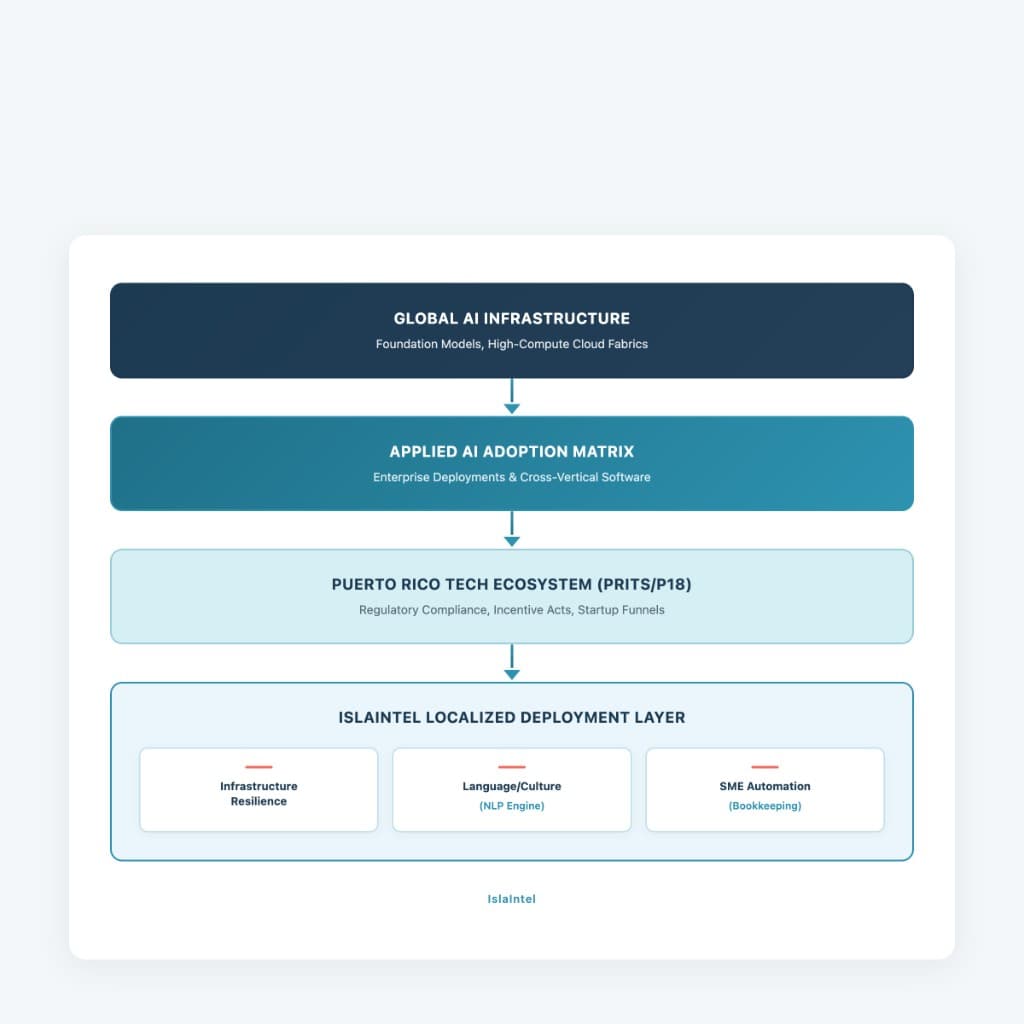
Figure 1. Puerto Rico AI ecosystem map: from global infrastructure and applied adoption through the PRITS/P18 regulatory layer to IslaIntel localized deployment vectors.
When narrowing our focus to Puerto Rico, the adoption landscape reveals a fascinating paradox:
| Segment | AI Adoption Profile | Integration Depth |
|---|---|---|
| Multinational corporations on-island | 94% advanced, centralized AI | Deep pipeline integration |
| Local enterprise (banks, insurers, retail) | High capital, strict compliance | Custom solutions, siloed data |
| Domestic SMEs | High intent, low formal deployment | Subscription tools, shallow integration |
| Island-wide aggregate | 84% | Stratified—surface vs. structural |
The Puerto Rico AI market segments into three distinct layers:
| Layer | Profile | Capital Need | Risk Profile |
|---|---|---|---|
| Startup & Applied AI | Agile teams leveraging pre-trained LLMs and computer vision for Caribbean/LATAM B2B workflows | Seed to Series A | High upside, localized moats |
| Enterprise Integration | Banks, aseguradoras, retail conglomerates with capital but constrained by privacy and silos | Enterprise contracts | Moderate—compliance-driven |
| SME Long-Tail | Operational backbone of domestic economy; labor-constrained, low technical expertise | Accessible SaaS / embedded AI | Volume play, education-heavy |
By leveraging IslaIntel's ecosystem mapping, investors can identify where these three segments intersect—deploying capital into applied software startups that turn corporate data liabilities into operational assets.
2.2 Will AI Replace Jobs in Puerto Rico? Reframing the Labor Paradox
The most significant headwind to Puerto Rico AI adoption is not technical friction, but deep-seated cultural anxiety regarding automated labor replacement. Research published in the Revista Caribeña de Psicología (2024) confirms that the primary psychological response among Caribbean employees regarding organizational AI integration is profound anxiety and fear.
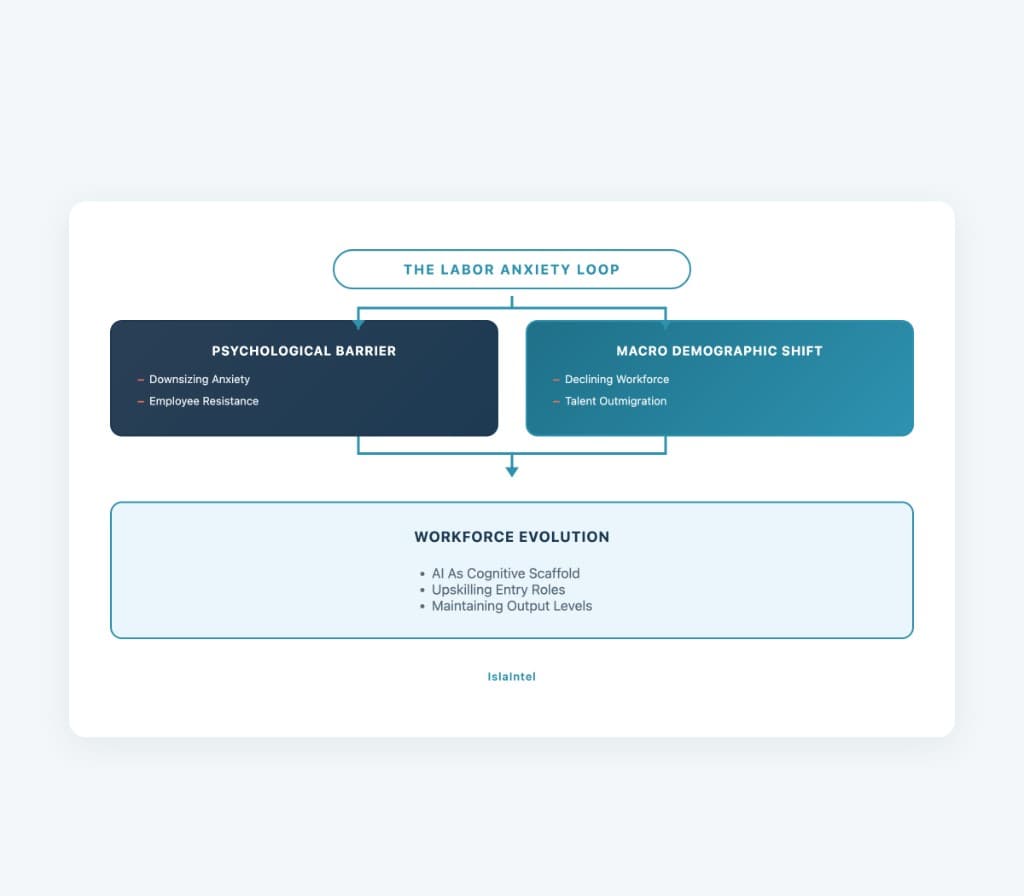
Figure 2. The Labor Anxiety Loop: how psychological barriers and macro demographic shifts converge into workforce evolution through AI as a cognitive scaffold.
For Puerto Rico, the risk of mass structural unemployment driven by AI is a secondary concern compared to the far more immediate crisis of a shrinking workforce. Driven by decades of economic stagnation, natural disasters, and continuous talent outmigration, the island cannot afford to view AI as a replacement tool—it simply lacks the surplus human capital to sustain baseline operational growth in traditional ways.
| Labor Dynamic | Continental Market | Puerto Rico Reality |
|---|---|---|
| Workforce trend | Stable / growing | Contracting (outmigration) |
| AI framing | Replacement risk | Augmentation necessity |
| Successful integration outcome | Efficiency gains | Upskilling + output preservation |
| Primary emotion (Caribbean IO research) | Mixed | Anxiety + fear of downsizing |
Workforce evolution means AI must be positioned as an essential cognitive scaffold that augments the existing labor force, enabling a static or diminishing worker pool to maintain high levels of productivity.
2.3 Where to Invest in Puerto Rico AI: Three High-Yield Vectors
| Vector | Regional Tension Point | Applied AI Solution | Defensive Moat |
|---|---|---|---|
| A — Infrastructure Resilience | Grid instability, power volatility | IoT sensor arrays + edge predictive maintenance | Island-specific telemetry datasets |
| B — Spanish NLP & Cultural AI | Spanglish, colloquial syntax, code-switching | Proprietary Puerto Rican dialogue datasets | Linguistic localization |
| C — SME Automation | Hacienda compliance, admin labor scarcity | OCR + financial models for back-office | Regulatory + workflow embedding |
Vector A: Puerto Rico AI for Infrastructure Resilience & Grid Prediction
Applied AI offers an immediate remedy through edge-computed predictive maintenance models. By deploying low-cost IoT sensor arrays across critical infrastructure nodes and processing telemetry through localized anomaly-detection algorithms, operators can forecast hardware degradation before catastrophic failure.
Signal inputs analyzed: thermal profiles · acoustic frequencies · voltage fluctuations
Operational shift: reactive, crisis-driven posture → predictive maintenance framework
Vector B: Puerto Rico Spanish NLP & Cultural AI Localization
Standard Spanish LLMs routinely fail to interpret the unique syntax, distinct idioms, code-switching behaviors (Spanglish), and rapid colloquial variations inherent to daily Puerto Rican commerce. Startups that refine models on authentic Puerto Rican dialogue unlock:
- Retail bank customer-support agents
- Insurance adjuster transcription
- E-commerce sentiment analysis
- Culturally calibrated automated service
Vector C: AI for Puerto Rico Small Businesses (SMEs)
Applied AI startups targeting the SME ecosystem embed intelligent automation into standard business software—automating invoice processing, categorizing expenses per Hacienda guidelines, and predicting supply-chain bottlenecks from historical shipping schedules.
2.4 Puerto Rico AI Regulation: PRITS, Senate Bill 68, and Act 40-2024
| Instrument | Authority | Key Mandates | Enterprise Impact |
|---|---|---|---|
| Senate Bill 68 / House Bill 2027 | PRITS | Dedicated AI Officer; public registries of commercial AI users; administrative fines | Compliance overhead + audit trails required |
| Act 40-2024 | Commonwealth | Zero-trust architecture across data fabrics; training protocols for entities >$100K revenue | Security infrastructure investment |
| Federal overlay | HIPAA, GLBA | Protected health and financial data handling | No unsecured public-cloud uploads |
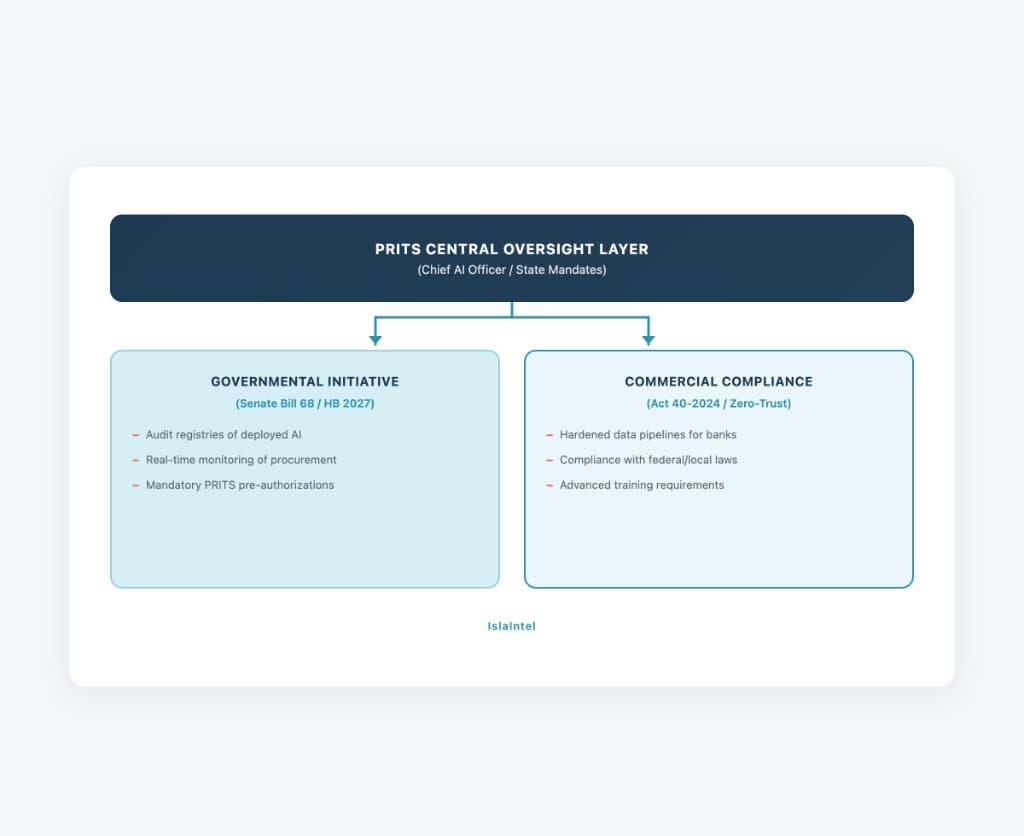
Figure 3. PRITS Central Oversight Layer: governmental AI initiatives under Senate Bill 68 and commercial compliance under Act 40-2024.
This regulatory environment creates immediate demand for software startups offering self-contained, locally compliant models with advanced data-masking capabilities and explicit audit logs.
2.5 The IslaIntel Puerto Rico AI Readiness Survey (2027)
IslaIntel is launching two targeted, multi-phase operational surveys designed to establish a definitive baseline for regional AI utilization.
Survey 1: Puerto Rico AI Readiness Benchmark 2027
| # | Dimension | Assessment Focus |
|---|---|---|
| 1 | Current Deployment Metrics | Non-existent → isolated testing → continuous operational integration |
| 2 | Infrastructure & Vendor Allocation | External public integrations vs. proprietary internal ML architectures |
| 3 | Strategic Budgetary Forecasting | % of CapEx allocated to AI licensing, infrastructure, developer recruitment (FY2027) |
| 4 | Perceived Operational Barriers | Talent gaps · privacy concerns · upfront costs · cultural resistance |
| 5 | Data Architecture Maturity | Structured, centralized, secure pipelines for training/fine-tuning |
| 6 | Regulatory Compliance Readiness | Confidence meeting PRITS guidelines and federal data protection laws |
| 7 | Linguistic & Cultural Friction | Degree off-the-shelf tools fail due to dialect, syntax, or localized gaps |
| 8 | Measurable Productivity Impact | Estimated efficiency variance where AI has been deployed |
| 9 | Talent Up-skilling Allocation | Internal education programs for prompt engineering and secure data workflows |
| 10 | 2027 Strategic Criticality | Scale 1–10: vital to long-term survival and competitiveness (12 months) |
Survey 2: Puerto Rico AI 5–10 Year Outlook — Decadal Horizon Survey
Designed for enterprise executives, public policy leaders, and technology directors. Key investigation areas:
- Structural employment changes over 5–10 years
- Long-term capital investment forecasts
- Electrical grid demand from local data processing
- Public policy adaptation for sustained economic growth
Survey Findings: The Realities of the Puerto Rican Market
| Finding Category | Empirical Reality | Strategic Implication |
|---|---|---|
| Intention–Adoption Gap | Majority lack formal integrated AI; overwhelming desire to deploy | Bottleneck is accessibility, not interest |
| Fear of Job Replacement | Prominent across owners and employees | Providers must frame AI as workforce empowerment |
| Structural Displacement Concerns | Fear of corporate downsizing accelerating regional vulnerability | Community anxiety is a deployment headwind |
| Technical Capital Deficit | SMEs lack deployment expertise | Embedded AI models outperform vendor-only SaaS |
Section III — Business Utilization and Implementation of AI
3.1 Reframing the Automation Narrative: Human Augmentation vs. Labor Replacement
IslaIntel's core framework explicitly positions AI not as an algorithmic substitute for human capital, but as a strategic tool designed to facilitate jobs, elevate worker output, and mitigate severe administrative burnout.
"Los resultados destacan el miedo hacia la integración de la IA en las organizaciones como la emoción principalmente experimentada. Hubo expectativas positivas sobre la optimización y eficiencia que permite la IA, y negativas como reducción de personal y pérdida de empleo."
— Velázquez-Santiago & Colón-Rivera (2024), Revista Caribeña de Psicología
Corporate implementation strategies must integrate psychological safeguards—training the internal workforce to interact with AI as a cognitive scaffold that reallocates labor toward high-value strategic decision-making, qualitative problem-solving, and relationship management.
3.2 Primary Operational Verticals
| Vertical | Applied AI Workflow | Human Role Preserved |
|---|---|---|
| Healthcare | Ambient AI scribes, EHR documentation, diagnostic foresight for chronic conditions | Physician diagnostic authority, patient consultation |
| Entertainment & Media | Multi-dialect transcription, color grading, subtitle localization, demand forecasting | Creative professionals, production talent |
| Real Estate | Computer-vision valuations, tenant NLP agents, IoT predictive maintenance | Showings, negotiations, client onboarding |
Vector A. Individual Healthcare Implementation
Ambient NLP engines securely capture patient-physician dialogue in real time, synthesizing clinical conversations into structured, compliant medical notes. Multi-modal patient datasets enable precise diagnostic foresight for chronic conditions like diabetes and cardiovascular disease—without replacing physician authority.
Vector B. Entertainment and Media Production
Machine learning automates post-production workflows (transcription, color grading, localized subtitles) while predictive models analyze streaming metrics and social sentiment to forecast demand—de-risking creative capital without displacing creative professionals.
Vector C. Real Estate and Property Management
Computer vision and predictive algorithms automate property valuations by cross-referencing municipal sales registries, zoning changes, tax compliance, and infrastructure proximity. Intelligent agents manage tenant communication and maintenance requests via localized NLP.
3.3 Secondary Vertical Horizons
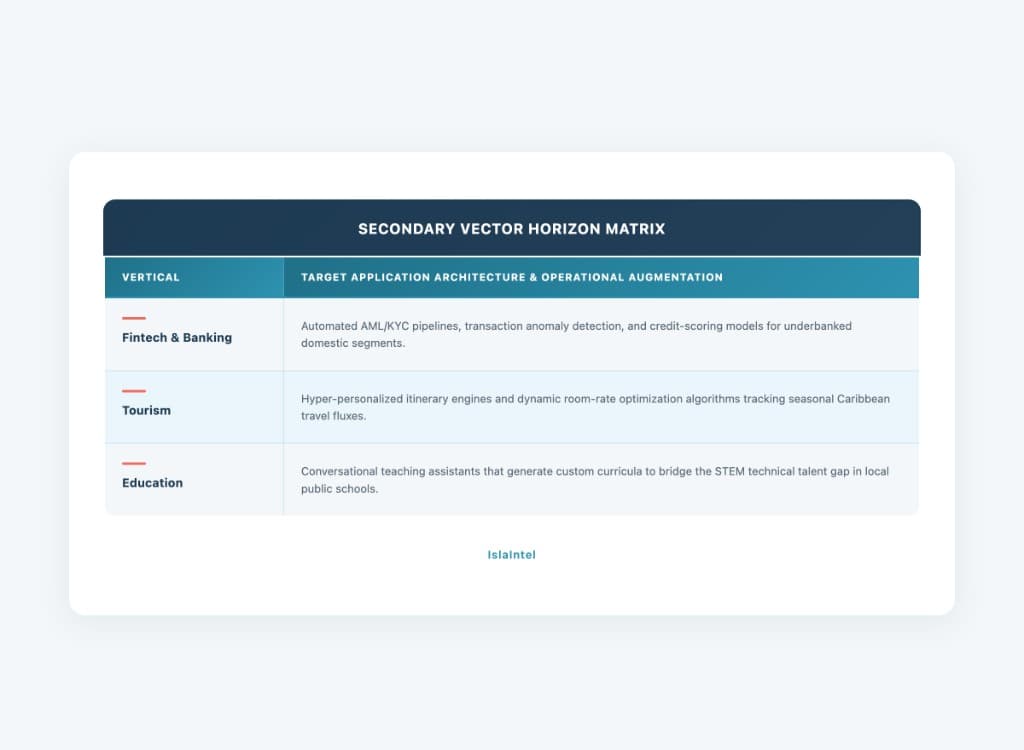
Figure 4. Secondary Vector Horizon Matrix: target AI application architectures across fintech, tourism, and education verticals in Puerto Rico.
Section IV — AI's Significance in Puerto Rico's Microeconomic Horizon and IslaIntel's Strategic Framework
4.1 The Forward-Looking Value Thesis: AI as an Economic Stabilization Engine
As Puerto Rico projects its macroeconomic trajectory into the late 2020s, artificial intelligence emerges as a critical infrastructure layer required for economic stabilization. Applied AI stands out as one of the few viable levers capable of driving non-inflationary productivity growth—allowing organizations to maintain or expand output despite a structurally constrained labor force.
| Macroeconomic Pressure | AI Stabilization Mechanism |
|---|---|
| Demographic contraction / outmigration | Augmentation of existing worker output |
| Unstable utility grids | Predictive infrastructure maintenance |
| Heavy regulatory compliance matrix | Automated compliance reporting |
| SME administrative squeeze | Back-office workflow automation |
4.2 IslaIntel's Intervention Model: De-risking Digital Integration through the Embedded Framework
IslaIntel operates as the Caribbean's first embedded AI resources department—integrating artificial intelligence seamlessly into existing business pipelines with institutional security, regional data compliance, and operational ROI.
| Phase | Focus Area | Key Activities | Deliverable |
|---|---|---|---|
| Phase 1 — Readiness | Readiness & Adoption Assessments | Data infrastructure audit, workflow bottleneck mapping, software dependency review | Customized automation roadmap |
| Phase 2 — Literacy | Literacy & Enablement | Hands-on internal training; non-technical AI interface management | Workforce proficient in secure AI workflows |
| Phase 3 — Validation | Validation & Safety Protocols | Sandbox testing, anonymization, algorithmic drift elimination | Production-ready, drift-free models |
| Phase 4 — Scaling | Autonomous Scaling (IslaWaves on OCI) | Multi-tenant AI agents, mission-critical workflow pipelines | Secure AI operations at enterprise scale |
| Phase 5 — Governance | Governance & Stewardship | PRITS alignment, Act 40-2024 compliance, audit trail hardening | Long-term regulatory compliance and data safety |
4.3 Addressing the Labor Paradox: Cultivating a Co-Pilot Culture
IslaIntel's deployment strategies counteract the fear of downsizing by building a collaborative Co-Pilot Culture:
| Traditional Role | AI-Assisted Evolution | Outcome |
|---|---|---|
| Administrative clerk (manual data entry) | Operational data auditor | Higher-value analytical position |
| Hospitality receptionist | Client relations + guest personalization | High-touch service focus |
| Back-office bookkeeper | Financial compliance reviewer | Strategic oversight role |
By keeping a human-in-the-loop across all automated deployment pipelines, IslaIntel protects worker agency and preserves organizational knowledge.
4.4 Ecosystem Infrastructure and Strategic Alliances
IslaIntel has established critical infrastructure alliances—chief among them the Oracle PartnerNetwork (OPN). By building IslaWaves on Oracle Cloud Infrastructure (OCI), IslaIntel gives local enterprises access to secure, high-performance computing optimized for heavy machine learning workloads.
| Alliance | Capability | Regulated Vertical Benefit |
|---|---|---|
| Oracle PartnerNetwork (OPN) | OCI-native security, data masking, encryption | HIPAA, GLBA, Act 40-2024 compliance |
| Enterprise cloud divisions | Accelerated time-to-value | Reduced capital barriers for LATAM digital transformation |
| Embedded training + infrastructure | Localized competency + tier-one compute | Puerto Rico as active AI economy leader |
References
Connecticut Department of Economic and Community Development. (2026). The Impact of Generative Artificial Intelligence on Regional Labor Dynamics: Workforce Upskilling and Entry-Level Role Evolution in Mid-Tier Ecosystems. State Economic Development Blueprints, Hartford, CT.
Goldman Sachs 10,000 Small Businesses Initiative. (2026). Small Businesses Embrace AI: Workforce Evolution, SME Scalability, and Operational Upskilling Performance. Goldman Sachs Voices Insights. Available at: https://www.goldmansachs.com/community-impact/10000-small-businesses-voices/insights/ai-presents-a-major-opportunity-for-small-businesses
IslaIntel LLC. (2025). How AI Is Transforming Small Businesses in the Caribbean: 5 Key Benefits You Can't Ignore. IslaIntel Insights Blog. Available at: https://islaintel.com/es/blog/how-AI-is-tranforming-business-in-the-caribbean
IslaIntel LLC. (2026). The IslaIntel Puerto Rico AI Readiness Survey and Decadal Horizon Projections. San Juan, Puerto Rico: IslaIntel Research Division.
McKinsey & Company. (2024). The State of AI in Early 2024: Global Adoption Baselines and Enterprise Scalability Trends. McKinsey Global Institute.
MZLS Administrative & Regulatory Legislative Audit. (2025). Artificial Intelligence Law in Puerto Rico (US): Institutional & PRITS Governance Layers under Senate Bill 68 and House Bill 2027. Legislative Tracking Series. Available at: https://www.ipu.org/impact/democracy-and-strong-parliaments/artificial-intelligence/parliamentary-actions-ai-policy
NEJM Catalyst. (2026). Ambient Artificial Intelligence and Clinical Documentation Dynamics: Alleviating Physician Burnout and Optimizing Individual Healthcare Outcomes. New England Journal of Medicine Catalyst Innovation Reports, 26(0128). Available at: https://catalyst.nejm.org/doi/full/10.1056/CAT.26.0128
Puerto Rico Innovation and Technology Service (PRITS). (2024). Government of Puerto Rico Artificial Intelligence Act (Senate Bill 68 / House Bill 2027) & Cybersecurity Governance Frameworks (Act 40-2024). La Fortaleza, San Juan, Puerto Rico.
Puerto Rico Legislative Assembly. (2024). Cybersecurity Integration Laws: Act 40-2024 Mandates on Zero-Trust Architecture for Public and Private Sector Data Fabrics. San Juan, Puerto Rico.
Smart AI Adoption Workshop Series. (2026). Lessons for Small Businesses: Operational Upskilling and Workforce Optimization. Connecticut Department of Economic and Community Development / CBIA Joint Initiative.
The National Law Review. (2026). IslaIntel Accelerates Business Automation in Caribbean and LATAM through Strategic Oracle Partnership. National Law Review Press Releases, OPN Global Deployment Corridors. Available at: https://natlawreview.com/press-releases/islaintel-accelerates-business-automation-caribbean-and-latam-through
V2A Consulting. (2024). The State of AI in Puerto Rico 2024: Benchmark Metrics on Enterprise and Local Operational Deployment Rates. V2A Insight Report. Available at: https://v2aconsulting.com/insights/state-of-ai-in-puerto-rico-survey-2025/
V2A Consulting. (2026). Puerto Rico AI Adoption Benchmarks and Corporate Stratification Analytics. Regional Market Reports, San Juan, Puerto Rico.
Velázquez-Santiago, J., & Colón-Rivera, M. (2024). Los desafíos de la automatización laboral: Explorando el miedo y las expectativas ante la integración de la Inteligencia Artificial en el entorno organizacional caribeño. Revista Caribeña de Psicología, 8(1), e10167. Available at: https://revistacaribenadepsicologia.com/index.php/rcp/article/view/10167